Amid Rising Fertilizer Uptake, Pupuk Indonesia Prepares 1.9 Million Tons of Stock for Planting Season
-
 Posted by User01
- Share


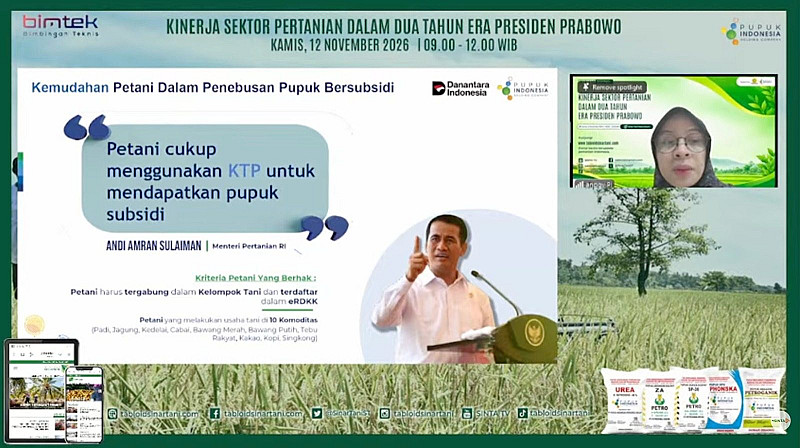
Jakarta, November 12, 2026 – PT Pupuk Indonesia (Persero) has prepared a total national fertilizer stock of 1,936,505 tons as of November 10, 2026, to meet farmers’ needs ahead of the planting season. Alongside this stock readiness, subsidized fertilizer distribution has increased by 14 percent compared to the same period last year. These developments have been supported by improvements in subsidized fertilizer governance under President Prabowo Subianto’s administration, which have simplified distribution procedures and provided greater certainty of fertilizer availability for farmers.
“Previously, fertilizer distribution involved several stages before reaching Line IV. Today, we are directly responsible for distribution all the way to the delivery points. With a more streamlined process, fertilizer availability at the farmer level has become more reliable,” said Vice President (VP) of PSO Sales Planning and Billing at Pupuk Indonesia, Anggy Fajar Maghfiroh, during a webinar organized by Sinar Tani on Thursday (November 12, 2026).
Anggy explained that the company’s national fertilizer stock comprises 1,556,278 tons of subsidized fertilizers and 380,227 tons of non-subsidized fertilizers.
The subsidized fertilizer stock consists of 909,600 tons of Urea, 550,041 tons of NPK, 18,142 tons of NPK Cocoa, 8,412 tons of SP-36, 3,906 tons of ZA, and 66,176 tons of organic fertilizers. Meanwhile, Pupuk Indonesia’s non-subsidized fertilizer stock comprises 325,232 tons of Urea, 20,723 tons of NPK, and 34,273 tons of ZA.
“These stocks are distributed across Pupuk Indonesia’s factory warehouses and buffer warehouses in various regions throughout Indonesia. Based on the current conditions, subsidized fertilizer stocks are estimated to be sufficient to meet farmers’ redemption needs for the next 55 days, assuming an average daily redemption volume of approximately 28,000 tons,” Anggy said.
To maintain fertilizer availability, she added, Pupuk Indonesia monitors inventory levels daily, including at district-level buffer warehouses. This monitoring is supported by the company’s digital transformation through its Command Center, which enables real-time oversight of production processes, shipments, vessel locations, fertilizer stocks in each district, and actual fertilizer redemption by farmers.
Anggy further explained that improvements in subsidized fertilizer governance and the Government’s efforts to simplify fertilizer access have also positively affected subsidized fertilizer uptake among farmers.
From January through November 10, 2026, subsidized fertilizer distribution reached approximately 7,709,711 tons, representing a 14 percent increase compared to approximately 6,789,854 tons distributed during the same period in 2025.
“The fertilizer industry has historically operated within a complex regulatory framework involving numerous regulations issued by various ministries and government agencies. Before President Prabowo’s administration, there were 145 regulations governing subsidized fertilizer management. Today, these regulations have been streamlined through a more integrated policy framework,” she explained.
These changes are based on Presidential Regulation No. 6 of 2025 concerning Subsidized Fertilizer Governance and its implementing regulations, including Minister of Agriculture Regulation No. 15 of 2025. Under these policies, state-owned fertilizer enterprises are responsible for distributing subsidized fertilizers directly to delivery points or designated fertilizer recipients.
Meanwhile, Secretary-General of the Ministry of Agriculture, Suwandi, who also participated as a speaker in the webinar, said that the Government’s fertilizer policies have delivered tangible benefits to farmers and national agricultural development.
According to Suwandi, several longstanding challenges frequently raised by farmers, including limited fertilizer volumes, high prices, and fertilizer shortages, are gradually being addressed through policy improvements.
He highlighted that the Government had successfully reduced the Highest Retail Price (HET) of subsidized fertilizers by 20 percent without increasing the burden on the State Budget (APBN). At the same time, the volume of subsidized fertilizers increased by up to 700,000 tons.
The Government is also planning the construction of several new fertilizer plants, with five plants targeted for inauguration before 2029.
In addition, changes to the raw material payment mechanism, from payments made after production to advance payments, have contributed to greater efficiency within the fertilizer industry.
Suwandi added that easier access to affordable fertilizers has also contributed to improvements in agricultural sector performance. Agricultural productivity has increased, farmers’ welfare has improved, and the agricultural sector has consequently become better positioned for stronger growth.
“The agricultural sector’s Gross Domestic Product (GDP) growth increased from 0.83 percent in 2024 to 5.74 percent in 2025. The Farmers’ Terms of Trade (NTP) index also rose from 124 to 132 over the same period,” Suwandi stated.