Pupuk Indonesia Ready to Support Indonesia’s Ambition to Become an Ammonia Hub in the Asia-Pacific
-
 Posted by User01
- Share


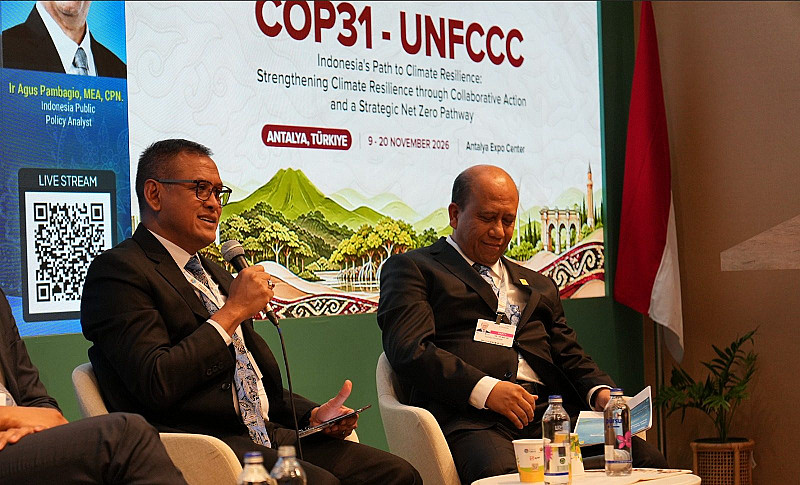
Antalya, November 9, 2026 – PT Pupuk Indonesia (Persero) outlined its vision to expand Indonesia’s national ammonia ecosystem as part of the global clean energy transition during the United Nations Climate Change Conference (COP31) in Antalya, Türkiye, on Monday (November 9, 2026). Through this initiative, Pupuk Indonesia aims to position Indonesia as an ammonia bunkering hub, serving as a marine fuel refueling center in the Asia-Pacific region.
President Director of Pupuk Indonesia, Rahmad Pribadi, said that ammonia, traditionally known as a key raw material in fertilizer production, also possesses promising characteristics as a future fuel, particularly for the maritime industry.
“The first chapter of ammonia’s story is about how it is used to produce food. The next chapter, however, is about its potential as an energy source. This presents an enormous opportunity, as demand is expected to continue growing,” Rahmad said.
To capitalize on this opportunity, Pupuk Indonesia has announced plans to develop an ammonia bunkering hub in Batam. The location offers a strategic advantage due to its proximity to the Strait of Malacca and major international shipping routes. Batam is also located near Singapore, one of the world’s leading marine bunkering centers.
“Indonesia’s geography is both a strength and a climate asset. Batam is particularly attractive because of its proximity to the world’s busiest marine bunkering hub. We see an opportunity to develop ammonia refueling facilities there, enabling vessels passing through the region to use ammonia as an alternative fuel,” Rahmad explained.
Beyond Batam, Pupuk Indonesia sees potential to expand the ammonia ecosystem by leveraging its existing production facilities in Lhokseumawe, Aceh, operated by PT Pupuk Iskandar Muda (PIM). Its location at the northern entrance to the Strait of Malacca provides a strategic advantage in supporting ammonia supplies along international shipping routes.
Pupuk Indonesia is also exploring the possibility of developing ammonia bunkering facilities in Bontang, East Kalimantan, integrated with the existing ammonia production facilities of PT Pupuk Kalimantan Timur (PKT). The availability of production facilities and established port infrastructure provides a strong foundation for expanding Indonesia’s national ammonia ecosystem.
These infrastructure development plans align with the growing adoption of ammonia as a fuel in the global maritime sector. According to Rahmad, the use of ammonia as a marine fuel is no longer merely a concept for future technological development. Several ocean-going vessels have begun adopting ammonia-powered engine technology, while ammonia bunkering activities have already taken place in several countries, including South Korea and Australia.
“This is not something that will only happen in the future. There are already vessels using ammonia, and refueling operations have also been carried out. This means the transition from conventional marine fuels to ammonia is already underway,” Rahmad said.
With an ammonia production capacity of 7.1 million tons per year, Pupuk Indonesia is well positioned to capitalize on this emerging opportunity. This capacity places the company among the largest ammonia producers across the Asia-Pacific, Middle East, and North Africa (APAC-MENA) regions.
Rahmad emphasized that Indonesia’s geographical position offers another competitive advantage in developing an ammonia bunkering hub. The country lies along major international shipping routes connecting key trade and industrial centers across Asia. This strategic location creates opportunities for Indonesia to provide ammonia refueling infrastructure for vessels navigating these routes.
“In the past, we used ammonia to help meet people’s food needs. Looking ahead, ammonia will become one of the important pillars of the energy transition. We recognize the significance of this transition and are committed to pursuing it seriously. Pupuk Indonesia has two mandates: supporting the nation in achieving food sovereignty and advancing industrialization toward more environmentally friendly industries. Today, these mandates have the potential to expand even further, as ammonia emerges as a fuel of the future,” Rahmad concluded.