Pupuk Indonesia's Growth for National Food Self-Sufficiency
-
 Posted by User01
- Share


Pupuk Indonesia’s operational performance growth is one of the foundations supporting National Food Self-Sufficiency. Through increased production, strengthened distribution, operational efficiency, and business transformation, Pupuk Indonesia continues to strengthen its capabilities to ensure fertilizer availability for farmers. These efforts are also reflected in the company’s continued financial growth.
From January to June 2026, Pupuk Indonesia recorded revenue of IDR 59.67 trillion, representing a 51% increase compared to the same period last year. EBITDA increased by 140% to IDR 14.28 trillion, while net profit reached IDR 8.51 trillion, growing by 253%. This growth was supported by increased production volumes and operational cost efficiencies as part of the company’s transformation.
Stronger financial performance is one indicator that the company has a healthy business foundation to carry out its strategic role. For Pupuk Indonesia, financial strength is not only about business performance, but also supports the company’s sustainability in carrying out its core responsibilities as a producer and distributor of fertilizers, including subsidized fertilizers, to millions of farmers across Indonesia.
Why Is Pupuk Indonesia’s Performance Important for National Food Self-Sufficiency?
Achieving food self-sufficiency requires support from various aspects, including the availability of agricultural inputs. Fertilizer plays an important role by providing the nutrients needed for crops to grow and achieve optimal productivity.
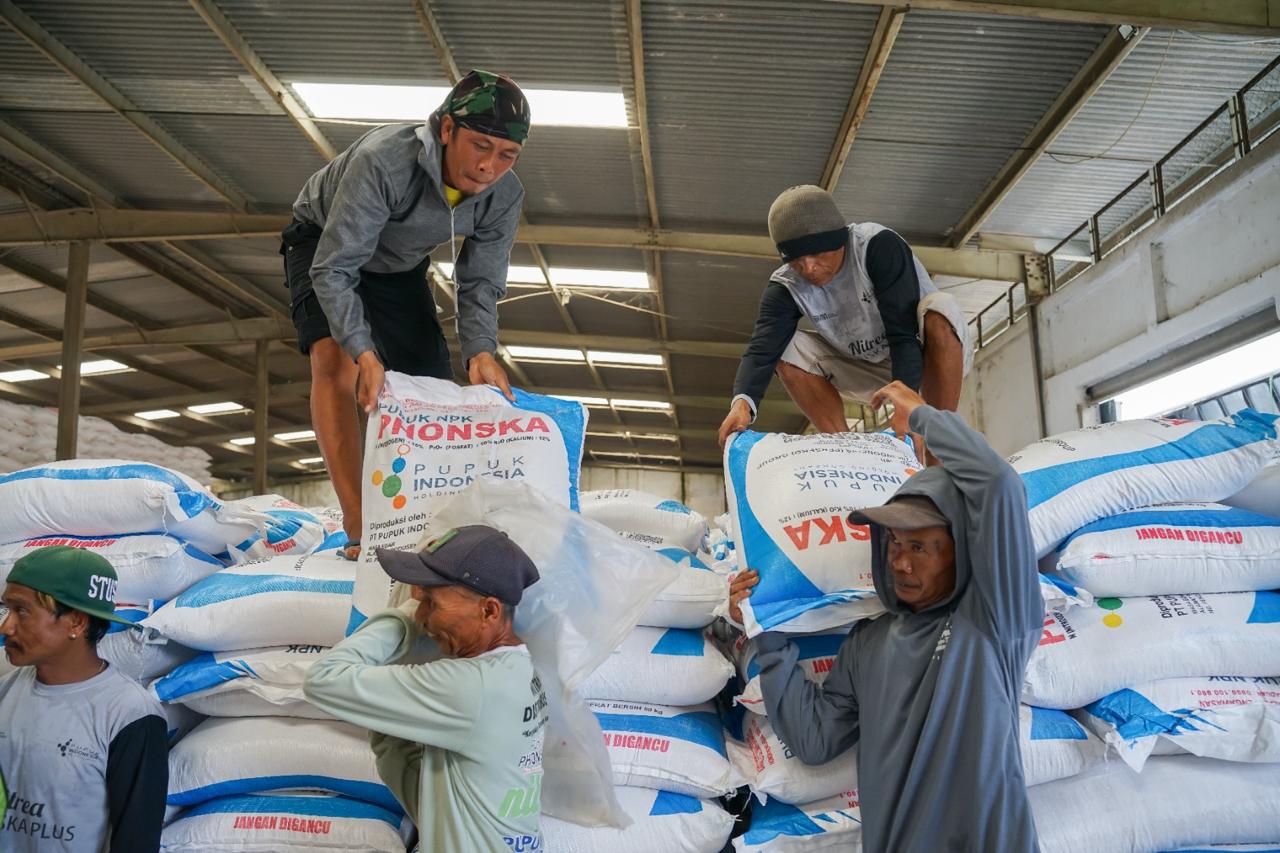
Pupuk Indonesia fulfills this role by managing the fertilizer supply chain end-to-end, from raw material procurement and production to storage and distribution to farmers. Therefore, the company’s ability to maintain strong operational and financial performance is closely linked to the sustainability of the national fertilizer supply.
Healthy financial performance provides the company with the capacity to maintain operations, conduct maintenance and revitalize production facilities, optimize assets, and strengthen distribution infrastructure. With a strong business foundation, Pupuk Indonesia can continue to fulfill its role in meeting national fertilizer needs.
Strengthening Fertilizer Production to Maintain Availability
One important aspect of Pupuk Indonesia’s operational performance is its ability to maintain fertilizer production. The company continues to optimize production facilities and improve plant reliability to ensure consistent production.
These optimization efforts include improving efficiency, maintaining facilities, revitalizing plants, and implementing technology in production processes. With a national production capacity of approximately 14.8 million tons per year, Pupuk Indonesia has sufficient capacity to support domestic fertilizer needs while responding to global market opportunities without disrupting fertilizer supplies for Indonesian farmers.
Asset management is also part of this strategy. Pupuk Indonesia has prepared a program to rejuvenate and revitalize seven plants over the next five years to improve productivity and increase asset value.
The ability to optimize and revitalize assets requires a strong financial foundation. Therefore, revenue, EBITDA, and profit growth are important indicators of the company’s ability to maintain operational sustainability while strengthening production capacity over the long term.
Fertilizer Distribution Reaches Farmers
Fertilizer production must be supported by effective distribution. Therefore, Pupuk Indonesia continues to strengthen its distribution network to ensure fertilizer availability across major agricultural regions.
The distribution of subsidized fertilizers is also undergoing transformation through simplified governance and the use of digital technology. Systems such as iPubers and the Command Center help the company monitor distribution processes, inventory, and fertilizer redemption in a more integrated manner.
Throughout 2025, Pupuk Indonesia successfully distributed 8,110,571 tons of subsidized fertilizer, an increase of 10.68% compared to the previous year. As of July 12, 2026, subsidized fertilizer distribution had reached 5.13 million tons, or 52% of the 9.8 million-ton allocation set by the government.
Therefore, Pupuk Indonesia’s performance is reflected not only in its ability to generate revenue and profit growth, but also in its ability to carry out its distribution function and ensure that fertilizer is accessible to farmers.
Operational Efficiency Strengthens Financial Performance
Pupuk Indonesia’s growth is also supported by the implementation of operational excellence and cost leadership. These two approaches are aimed at improving productivity while maintaining cost efficiency.
Operational excellence focuses on improving process effectiveness, plant reliability, asset optimization, and resource productivity. Meanwhile, cost leadership emphasizes disciplined cost management to enable the company to remain competitive.
The impact of these efforts can be seen in the company’s financial performance. In the first half of 2026, Pupuk Indonesia’s EBITDA grew by 140% to IDR 14.28 trillion, while net profit increased by 253% to IDR 8.51 trillion. This growth demonstrates that increased business and production activities have been accompanied by efforts to maintain operational cost efficiency.
Stronger financial performance provides an important foundation for operational sustainability. The healthier the company’s financial condition, the greater its ability to maintain plant reliability, develop infrastructure, revitalize assets, and strengthen its fertilizer distribution system.
Transformation Supports the National Food Self-Sufficiency Agenda
Ultimately, these performance improvements serve a broader purpose. Pupuk Indonesia is not only growing as a business entity but also strengthening its contribution to the national food security agenda.
This is aligned with the administration of President Prabowo Subianto, which has positioned National Food Self-Sufficiency as one of the country’s strategic priorities.
In this context, the relationship between financial performance and National Food Self-Sufficiency can be seen through the company’s ability to maintain operational sustainability. Growing revenue, stronger EBITDA, and increased profit provide a foundation for the company to continue investing, maintaining production facilities, strengthening distribution, and ensuring fertilizer availability for farmers.
In other words, healthy financial performance is not an end in itself. It serves as an indicator of the company’s overall health while supporting Pupuk Indonesia’s ability to fulfill its primary role as a fertilizer producer and distributor for millions of farmers across Indonesia.
How Is Pupuk Indonesia’s Performance Connected to National Food Self-Sufficiency?
The relationship between Pupuk Indonesia’s performance and National Food Self-Sufficiency can be seen through several stages:
1. Healthy financial performance strengthens business sustainability
Revenue, EBITDA, and profit growth provide a foundation for the company to maintain and develop its operations.
2. Strong operational performance ensures fertilizer availability
Optimal production and reliable plants help maintain fertilizer supplies to meet national agricultural needs.
3. Effective distribution ensures fertilizer reaches farmers
A strengthened distribution network and digitalization help improve the visibility and accuracy of fertilizer distribution.
4. Efficiency strengthens the company’s competitiveness
Disciplined cost and asset management help the company maintain business sustainability amid fluctuations in raw material prices and global market conditions.
5. Fertilizer availability supports agricultural productivity
Fertilizer availability in line with farmers’ needs helps ensure access to the agricultural inputs required to improve crop productivity.
This chain demonstrates that Pupuk Indonesia’s financial and operational performance, as well as its contribution to the agricultural sector, are closely interconnected.
Pupuk Indonesia’s Growth for Food Security
Pupuk Indonesia’s growth is part of a transformation covering production, distribution, efficiency, digitalization, and asset optimization. The results of this transformation are also reflected in the company’s financial performance.
In the first half of 2026, Pupuk Indonesia recorded IDR 59.67 trillion in revenue, IDR 14.28 trillion in EBITDA, and IDR 8.51 trillion in net profit. Growth across these indicators demonstrates stronger business performance while providing the company with a stronger foundation for sustainable operations.
If Pupuk Indonesia’s financial performance continues to grow while remaining healthy, it will serve as an important indicator of the company’s continued ability to fulfill its role as a fertilizer producer and distributor. A strong financial foundation supports the company in maintaining production, carrying out plant maintenance and revitalization, strengthening distribution, and ensuring that fertilizer remains available and accessible to farmers.
This strength not only contributes to Pupuk Indonesia’s growth as a business entity but also supports the broader national agricultural ecosystem. Sustained fertilizer availability helps improve farmers’ productivity and forms part of the collective effort to achieve National Food Self-Sufficiency.