Production Capacity of 14.8 million tons, Pupuk Indonesia Is Ready To Fulfill The Planting Season Needs
-
 Posted by
- Share


The readiness of fertilizer supplies is a crucial factor in ensuring a smooth planting season. Pupuk Indonesia is prepared to meet national fertilizer demand, backed by a production capacity of 14.8 million tons per year.
This capacity is central to Pupuk Indonesia's readiness to maintain fertilizer availability for various agricultural needs, including during periods of peak demand throughout the planting season. Through the management of production facilities and efficiency improvements, Pupuk Indonesia continuously optimizes its capacity to ensure that fertilizer supplies are available to meet requirements.
Pupuk Indonesia’s Production Capacity Reaches 14.8 Million Tons per Year
Pupuk Indonesia possesses a fertilizer production capacity of approximately 14.8 million tons per year, covering various types of fertilizers such as urea, NPK, ZA, and ZK. This capacity is supported by five subsidiary fertilizer producers with facilities located across various regions of Indonesia.
Pupuk Indonesia’s five main production facilities are:
● PT Pupuk Sriwidjaja Palembang (Pusri) in Palembang, South Sumatra.
● PT Pupuk Kujang in Cikampek, West Java.
● PT Petrokimia Gresik in Gresik, East Java.
● PT Pupuk Kalimantan Timur (PKT) in Bontang, East Kalimantan.
● PT Pupuk Iskandar Muda (PIM) in Lhokseumawe, Aceh.
These five companies form part of Pupuk Indonesia’s production network, supporting the supply of fertilizer for the agricultural and industrial sectors.
The presence of production facilities across various regions also enables integrated capacity management. Each facility possesses distinct production characteristics and product outputs, allowing the company to meet fertilizer demands based on specific types and market needs.
Ensuring the Availability of Raw Materials for Fertilizer Production
Fertilizer production readiness depends not only on facility capacity but also on the availability of raw materials. Consequently, Pupuk Indonesia secures raw material supplies as part of its efforts to maintain production continuity.
Natural gas is a primary raw material for nitrogen-based fertilizer production. Pupuk Indonesia continuously strives to secure gas supplies from domestic sources to support ongoing production.
Meanwhile, the production of fertilizers requiring phosphorus (P) and potassium (K) still relies on imported raw materials. To ensure supply continuity, Pupuk Indonesia diversifies its raw material sources across various countries.
Managing these raw materials is crucial for maintaining the reliability of the production supply chain. With well-planned raw material supplies, production facilities can operate more optimally, and the risk of production disruptions can be minimized.
What Is the Fertilizer Production Capacity for 2026?
In 2026, Pupuk Indonesia targets the production of various types of fertilizer to meet national needs. The production capacity comprises:
● Urea: 9.4 million tons
● NPK: 4.5 million tons
● Other fertilizers: 0.8 million tons
This target is part of production planning designed to ensure that available facilities are optimized to meet fertilizer demand.
Production planning must also be aligned with market needs and fertilizer requirements across various planting periods. Consequently, readiness for the planting season is supported by well-planned production management.
Production Optimization through Digitalization
Pupuk Indonesia continues to strengthen its business processes by implementing technology and digitalization across its production lines. This initiative is part of the adoption of Industry 4.0 technologies aimed at enhancing efficiency, reliability, and operational control precision.
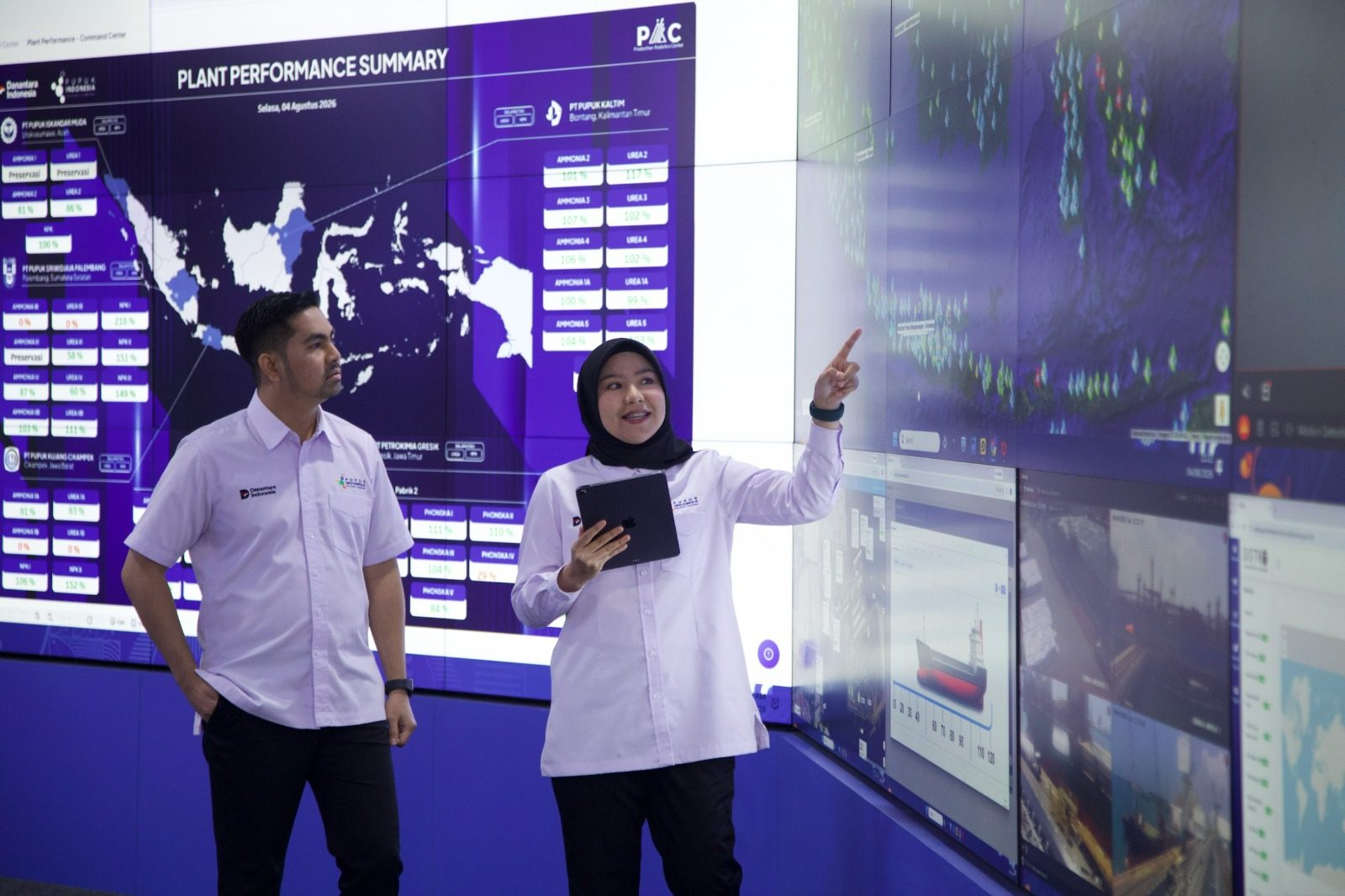
In the manufacturing industry, digitalization enables companies to obtain operational data more quickly and accurately. This data can be used to monitor facility conditions, identify potential disruptions, and facilitate decision-making based on actual conditions in the field.
In the fertilizer production process, real-time monitoring enables companies to gain a comprehensive view of equipment performance and production workflows. Consequently, potential disruptions can be identified early, allowing for more strategic maintenance planning.
Pupuk Indonesia has integrated technologies such as big data and the Internet of Things (IoT) into its production processes. Over 32,000 sensors have been installed across 48 production facilities to facilitate real-time monitoring of operational conditions.
The adoption of these technologies goes beyond mere automation; it supports efficient resource utilization, enhances facility reliability, and improves production process control. Digitalization serves as a crucial foundation for the manufacturing industry, helping to maintain productivity while strengthening the company's ability to respond to changing demands.
The planting season is a critical period requiring careful preparation for fertilizer needs. Adequate production capacity ensures that the demand for fertilizer is supported right from the production stage.
Fertilizer production capacity plays a vital role in:
● Ensuring fertilizer availability for the agricultural sector.
● Meeting the demand for various fertilizer types tailored to crop and market needs.
● Maintaining supply readiness leading up to and during the planting season.
● Supporting sustainable planning for fertilizer production and distribution.
Therefore, readiness for the planting season extends beyond the distribution of fertilizer to end-users; it begins with the preparedness of production facilities and capacity.
Revitalization and Development of the Fertilizer Industry
In addition to optimizing existing facilities, Pupuk Indonesia is revitalizing and expanding its production facilities to ensure the long-term competitiveness of the fertilizer industry.
Pupuk Indonesia operates more than 20 fertilizer plants that have been in service for over two decades. Consequently, facility modernization is a key component of the strategy to boost efficiency, operational reliability, and plant productivity.
Over the next five years, Pupuk Indonesia aims to construct and revitalize seven plants. These initiatives are designed to improve energy efficiency, production capacity, and facility operational reliability.
One such project is the construction of the Pusri III-B plant, which is set to replace the existing Pusri III and IV facilities. The new plant is designed with more efficient technology, particularly regarding gas usage as a feedstock for urea production. This development is part of an effort to enhance efficiency while ensuring the sustainability of production capacity.
Pupuk Indonesia is also revamping the Ammonia Plant-2 at Pupuk Kalimantan Timur to improve gas utilization efficiency. This program is part of a facility optimization initiative aimed at boosting the performance of production assets.
Regarding capacity and portfolio expansion, Pupuk Indonesia is constructing an NPK Nitrate plant at Pupuk Kujang Cikampek. This plant is one of seven construction and revitalization projects undertaken by the company to strengthen the national fertilizer industry.
Industry development also encompasses product diversification and downstream expansion. For instance, Pupuk Indonesia is developing a Soda Ash plant in Bontang, alongside other projects such as methanol and clean ammonia development. These measures aim to maximize the value derived from the company's resources and industrial portfolio.
This series of revitalization and development initiatives demonstrates that strengthening production capacity involves more than just operating existing facilities; it also entails technological upgrades, efficiency improvements, and the construction of new facilities tailored to industry needs.
Strengthening the Foundation for Sustainable Fertilizer Production
Production capacity is a crucial pillar in maintaining the sustainability of the fertilizer industry. However, production capability depends on more than just the scale of installed capacity.
Facility reliability, feedstock availability, technology utilization, energy efficiency, and the modernization of production facilities are all interconnected factors in ensuring the continuity of the production process.
Through measures such as securing feedstock, digitizing production processes, optimizing facilities, and revitalizing and expanding plants, Pupuk Indonesia continues to strengthen the foundation of the national fertilizer industry. These steps enhance the company's ability to manage production capacity efficiently and ensure a sustainable supply of fertilizer to meet Indonesia's agricultural needs.